
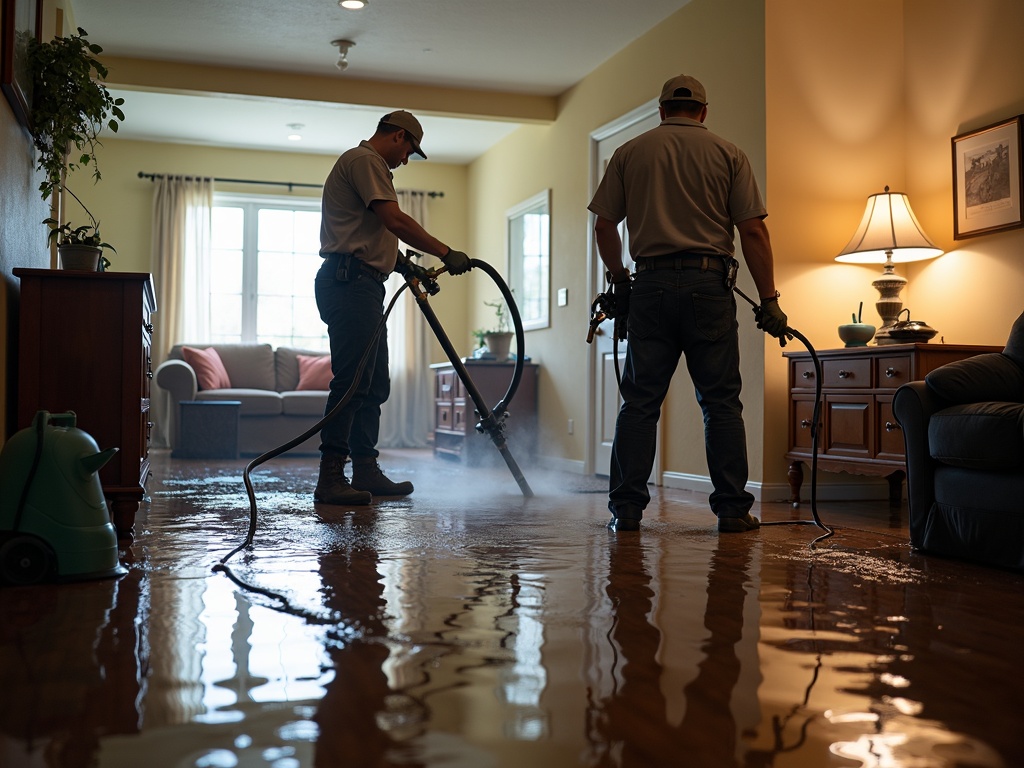
7 Essential Tools and Techniques Pros Use to Dry Out a Saturated Home
If your home floods, the last thing you want to do is nothing. But ironically, that’s exactly what you should do, at least, until you call your insurance company and a water damage restoration company. Then, you should do as little as possible.
Thermal Imaging Finds What Your Eyes Miss
The costliest error you can make is drying the visible part of the water loss and overlooking the invisible. Water spreads. It goes into wall cavities. It wicks across the subfloor assembly. It pools unnoticed behind baseboards.
That’s when the thermal imaging camera comes into play. Thermal imaging cameras detect temperature variances in building materials. And wet holds temperature differently than dry. A properly trained technician, reading an infrared scan, can isolate a saturated wall cavity before it ever becomes discolored. That’s the step that keeps a six-month-old mold problem from turning into a $30,000 remediation.
The Drying Triangle, Not Just Heat
Experts adhere to the drying triangle philosophy: the equilibrium between air movement, humidity reduction, and temperature. Remove one element and the whole cycle is interrupted.
The air movers are high-speed devices that eliminate the humid air boundary layer found near wet surfaces. They don’t work like ordinary fans. Instead, they focus the air at just the right angle to speed up evaporation on the floor, walls, and other structural elements.
Regarding LGR dehumidifiers (Low Grain Refrigerant), this is where professional drying separates itself from consumer-level solutions. A regular dehumidifier will slow or stop working when room humidity gets too low. An LGR dehumidifier will continue to extract humidity when the air becomes incredibly dry, as it does during the final phase of the process. Consumer units give up, LGR units get the job done.
Temperature also plays a crucial role. Warm air is capable of absorbing more moisture, which means more water can be released from your belongings and trapped by the dehumidifier. Cold temperature makes the process much slower.
Measuring What You Can’t See
A penetrating moisture meter, the pin-style instrument professionals trust, indicates the actual moisture level inside a wood subfloor or wall stud. Visual examination indicates nothing beneficial. A reading of 19% moisture in framing lumber appears and feels absolutely dry, but it is over the threshold at which mold can develop.
Technicians utilize hygrometers to measure relative humidity and temperature levels throughout the structure, and this information, in conjunction with the moisture readings, is used to create a moisture map, a room-by-room record of influenced materials and drying status. Guesswork is not an option when it comes to insurance companies. They demand documented verification that the structure is dry before they will permit reconstruction. And without a moisture map, they understand that it is simply a guess.
Saving Materials Instead of Removing Them
Hardwood floors and built-in cabinetry are expensive. The default for underskilled crews is removal. Professional restoration often saves both.
Sub-floor drying systems, injection-based equipment that forces conditioned air through a manifold between flooring layers, can dry hardwood from the underside without removal. It’s slower than tearing it out. It’s significantly cheaper for the homeowner and preserves finishes that can’t be replicated.
Carpets are often "floated," meaning lifted from the tack strip, padding removed, and air movers directed underneath the carpet layer itself while the subfloor dries independently. Done within the right window, carpet is often salvageable.
Regional Knowledge Changes Everything
All water loss circumstances are unique and need to be treated as such. A company like Servpro of Greater Smithtown works in a specific regional market where older construction, finished basements, and particular building assemblies create drying challenges that a generic national protocol won’t fully address. Local construction knowledge directly affects where equipment gets placed, how long drying takes, and which materials are worth saving.
Speed matters here too. According to the IICRC, professional drying can often be completed in 3 to 5 days, but improper drying can allow mold colonies to form in as little as 24 to 48 hours. The window between "wet home" and "mold problem" is short. Regional companies with local equipment inventory respond faster than crews traveling distance.
When the Water Isn’t Clean
Water damage caused by sewage backup, rising groundwater, or any type of water containing biological or organic contaminants, presents serious health risks and must be decontaminated before the use of drying equipment. The air moving machines will only spread microorganisms throughout the structure. Antimicrobial solutions are applied to affected porous materials as part of the remediation work, not during the drying phase.
Homes constructed before 1978 could also be at risk since paint containing lead may have been disturbed during the removal of wet building materials. This type of clean-up requires the crew to be EPA Lead-Safe Certified and to follow specific documentation practices.
Drying a flooded home correctly is an engineering problem. The difference between a crew that treats it that way and one that doesn’t usually shows up three months later, inside your walls.